
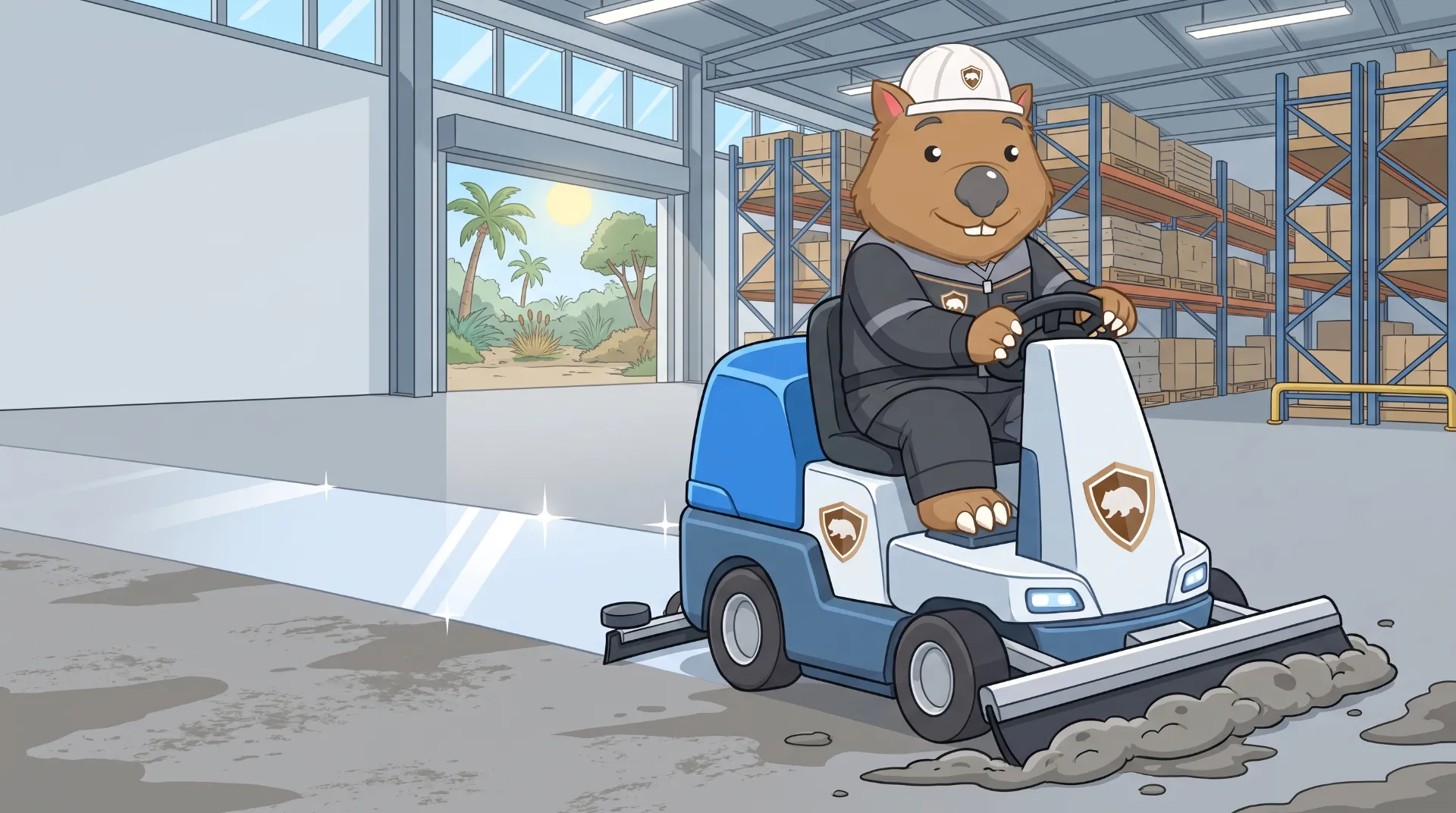
What a scrubber actually removes
A scrubber does four things in one pass: lays down water and detergent, agitates the surface with pads or brushes, then squeegees and vacuums the dirty solution straight back off the floor. That last step is the one that separates a scrub from mopping — the soil leaves the building instead of drying back into the slab.
What it lifts: tyre rubber and forklift marks, oil and hydraulic film, traffic grime, spilled product residue, cement slurry and render splatter from construction, and the general grey haze that makes a well-built car park look neglected.
What it won't fix: chewing gum, deep oil that has soaked into unsealed concrete, rust staining, or paint. Those are spot jobs — usually high pressure cleaning with heat, or specialist treatment.
Pads, brushes and grit
The head is where jobs are won or wrecked. Matching the tool to the floor's profile and hardness matters more than the size of the machine.
| Floor | Use | Why |
|---|---|---|
| Broom-finished concrete | Stiff brushes | Bristles reach into the texture; a pad only rides across the high points. |
| Sealed / burnished concrete | Medium pads | Cuts the film without scouring through the seal you paid for. |
| Polished concrete / terrazzo | Soft / diamond-impregnated pads | Aggressive grit leaves swirl marks that are visible under lights forever. |
| Multi-level car park deck | Brushes + heavier down-pressure | Rubber build-up in turning circles needs real mechanical force. |
Ask what grade of pad or brush is going on your floor. On a polished slab it is a fair question and a good contractor will have an answer ready.
Water in, water out
A scrubber carries two tanks: clean solution out, recovered dirty water back. If the recovery system is underperforming — worn squeegee blades, a blocked hose, a full tank nobody emptied — the machine stops cleaning and starts spreading. You'll see it as streaks, a tide mark at the edge of each pass, or a floor that dries patchy.
Good recovery has a second benefit: the floor is walkable almost immediately behind the machine. That is what makes overnight scrubbing viable in a shopping centre or a warehouse that opens at 5am.
Recovered water is trade waste, not stormwater. It should be disposed of to an approved point — ask where it's going.
Chemical, dwell and doing it twice
Detergent needs time to work. On a heavily soiled floor the honest method is two passes: lay solution down and let it dwell, then come back and scrub and recover. One rushed pass on a floor that hasn't been touched in five years will lift maybe half of what's there — and the client reasonably concludes that scrubbing doesn't work.
It also means the first scrub on a neglected floor is not the same job as the maintenance scrub that follows. Expect the restoration clean to cost more and take longer, then a routine cycle to hold it there far more cheaply.
Slip resistance and safety
The film that builds up on a trafficked floor — rubber, oil, dust bound together — is exactly what makes it slick when it gets wet. Removing it improves grip. The real risks during the job are wet floor in a live area and cables across a walkway, which is why scrubbing in public areas belongs after hours with signage and a defined work zone.
In food, pharmaceutical and hospital environments there's a further point: a scrubber with a clean recovery tank is a hygiene tool. One with a fouled tank is a way to move bacteria evenly around your floor.
Construction hand-over cleans
This is where scrubbing earns its keep. A new floor plate carries cement slurry, plaster dust, adhesive residue and tracked mud, and it has to present clean on a fixed date with trades still finishing around you.
The sequence that works: sweep the whole area, scrub with brushes and adequate dwell, detail the edges and columns by hand, then pressure clean external entries and paving last. Book it late enough that the wet trades are done and early enough that you're not cleaning at 2am the night before handover.
Scrubbing FAQ
How long until we can drive or walk on it?
With good recovery, minutes. The floor is damp rather than wet behind the squeegee, and we'll stage the work so your opening area is done first.
Will one scrub fix a floor nobody has cleaned in years?
It will make a dramatic difference, but a deeply neglected slab may need two passes or a second visit. We'll tell you that up front rather than after.
Can you scrub a polished concrete floor safely?
Yes, with the right pad grade and neutral chemical. Tell us it's polished before we arrive — the wrong pad on a polished slab is not a mistake you can undo with another clean.
How often should a warehouse floor be scrubbed?
Monthly to quarterly for most distribution centres, with weekly sweeping in between. Food and pharma facilities usually run tighter cycles than that.
Do you supply water and power?
Our machines are self-contained, but a tap on site speeds up tank refills on large jobs. If there's no water available, say so when you book and we'll plan for it.