Written by Mark Scull, founder of Wombat Sweepers · Published · Last updated
The four cost drivers
| Driver | What it is | What moves it |
|---|---|---|
| Machine hours on site | The time the machine actually runs, not the size of the area | Clutter, parked cars, trades, pallets, speed humps, tight turning circles, height limits |
| Travel | Getting the machine to site and back, including float time | Distance from the Cornubia depot; whether your job joins an existing run |
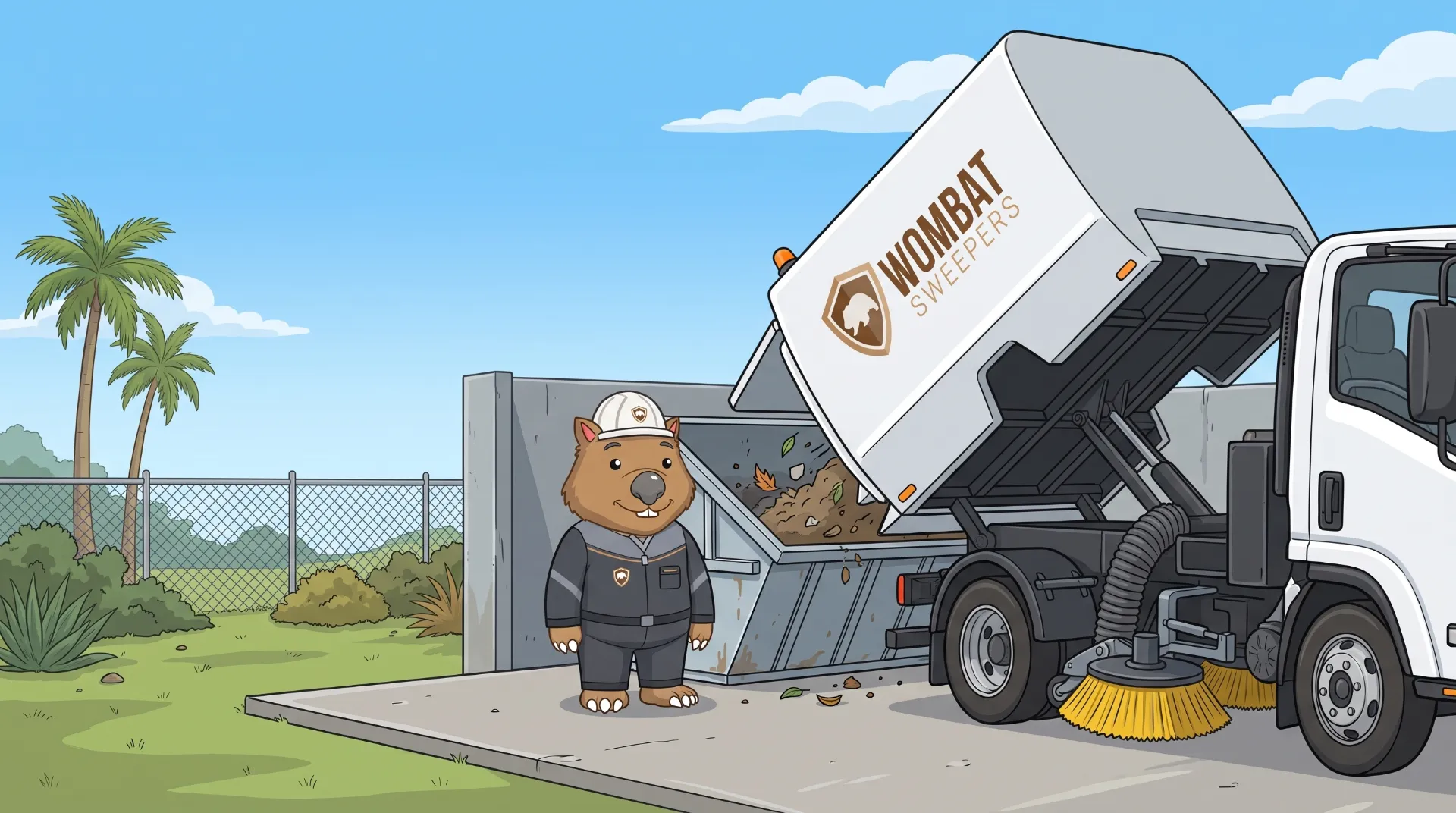
| Hopper tips | Each discharge of captured material at a disposal point | How much material is on the surface, and hopper capacity of the machine sent |
| Disposal | Tipping fees at a facility licensed to accept the material | Volume and material type. Contaminated material is quoted separately or declined |
Why hourly rates differ so much
A truck-mounted regenerative-air street sweeper is a very different asset to a walk-behind sweeper, and the rate reflects the machine rather than the contractor’s mood. Be suspicious of a road sweeping rate that looks like a car park rate — it usually means a smaller machine is coming than the one you pictured.
| Machine class | Relative cost per hour | Relative area per hour |
|---|---|---|
| Walk-behind sweeper or scrubber | Lowest | Lowest — aisles and tight spaces |
| Ride-on sweeper | Moderate | High on open decks and slabs |
| Ride-on scrubber | Higher than a ride-on sweeper | Lower than sweeping — it is slower and uses consumables |
| Truck-mounted road sweeper (wet hire) | Highest | Highest per lane-kilometre, and the only option on a public road |
| High pressure unit with surface cleaner | Moderate | Lowest per square metre — it is a detail service |
That table is deliberately relative rather than absolute. For the actual dollar figures on your site, ask for a rate card — we will send the machine classes, hourly rates, tip and disposal charges and travel in writing.
What makes a site expensive
Clutter and access, almost every time. A site that can be cleared for an hour is dramatically cheaper than the same site half-occupied, because machine hours are what you are paying for.
- Parked cars and live trades — the machine spends its time reversing rather than sweeping
- Height limits — a basement that excludes the efficient machine forces a smaller, slower one
- Tight turning circles — more passes, more time
- Speed humps and islands — slow the run and leave hand-work behind
- Heavy material loads — more hopper tips, more disposal
- Wet clay or saturated mud — smears rather than lifts and blinds the filters. We would rather re-book than charge you for moving mud around
The inverse is also true, and it is the cheapest lever you control: clear the area, book out of hours, and give us a straight run.
How to compare two quotes fairly
Ask both contractors the same three questions and the gap usually explains itself.
Machine class, sweeping width and hopper capacity. A cheaper quote with a smaller machine is not a cheaper job.
A fixed price built on two hours is a different product to one built on four. Ask what happens if it runs over.
If it is not a separate line, ask where it is. Captured material has to go somewhere that charges to take it.
Where contracts save money
A one-off clean carries the full travel and a full hopper. A contract cycle means less material each visit, shorter machine hours, and travel shared with other sites on the run.
| Frequency | Typical sites | Effect on cost per visit |
|---|---|---|
| Weekly | Busy retail, fast-food forecourts, transport depots, distribution centres | Lowest per visit — light loads, short machine hours, shared travel |
| Fortnightly to monthly | Neighbourhood centres, strip retail, industrial estates, warehouse hardstand | Low per visit; the most common landing point |
| Quarterly | Low-traffic parking, completed residential streets | Higher per visit — more material has accumulated |
| One-off | Hand-over cleans, first deep cleans, reactive call-outs | Highest per visit — full travel, full hopper, no shared run |
Pricing questions
Something else? Call 1300 387 713 and talk to someone who runs the machines.
How much does commercial sweeping cost?
It is quoted on machine hours on site, travel, the number of hopper tips the job needs and disposal. A large open car park with one tip is cheap per square metre; a small cluttered site that fills the hopper twice is not. Ring with the suburb and the approximate sealed area and you will get a real number, not a range.
Why will you not publish an hourly rate?
Because an hourly rate without a machine class attached is meaningless — a walk-behind sweeper and a truck-mounted regenerative-air street sweeper are different assets with different costs. We quote the machine and the hours together so you can compare like with like.
Is disposal included?
Yes, and it is shown as its own line rather than buried in the rate, so you can see what it costs.
Is there a minimum charge?
There is a practical minimum: the machine still has to be loaded, floated and returned. Very small one-off jobs price better when they can join a run already heading your way.
Do contracts cost less than one-off cleans?
Per visit, almost always. Less material arrives each visit, machine hours drop, and travel is shared with other sites on the run. Most clients who move from ad-hoc to scheduled sweeping pay less per visit and get a cleaner site.
Can you beat a cheaper quote?
We would rather explain the difference. Two quotes 30% apart are usually quoting different machines or different hour allowances — and the cheaper one often comes back for a second visit you also pay for.