
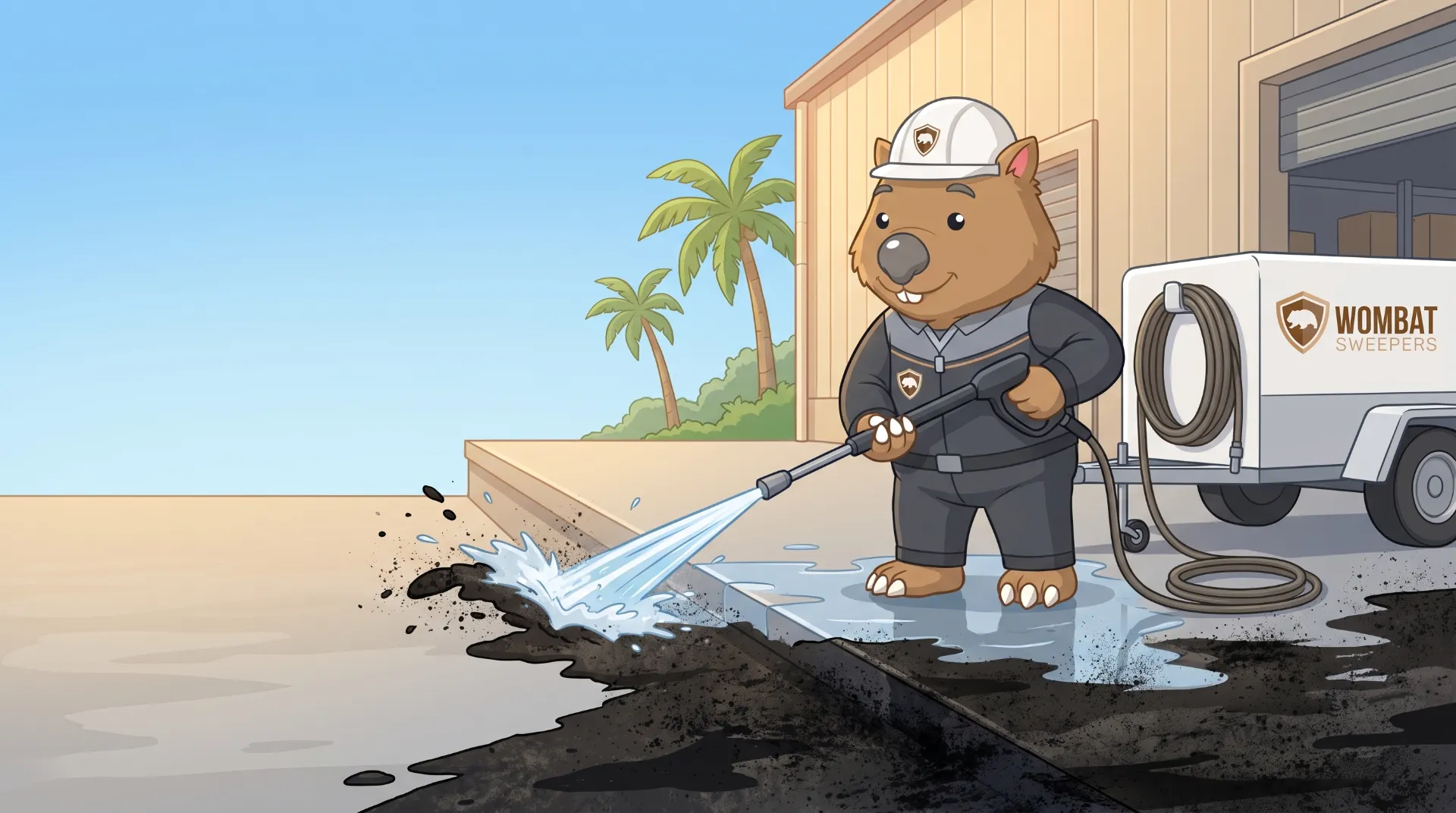
Pressure, flow and heat
Pressure breaks the bond between the soil and the surface. Flow — litres per minute — carries the released material away and is what actually covers ground. Heat dissolves anything oily, which cold water can only smear.
Domestic units chase pressure and have almost no flow, which is why a home washer cuts clean stripes into a driveway and takes an afternoon to do a single bay. Commercial gear trades some pressure for far more flow, so a whole forecourt comes up evenly in one pass with no tiger stripes.
Heat is the one people skip to save money. On grease at a loading dock, gum outside a food court, or a fryer-oil spill behind a restaurant, cold water is close to useless — you'll spread the contamination over a wider area and call it clean because it's wet.
Surface cleaner, wand or turbo?
| Tool | Use it for | Risk |
|---|---|---|
| Rotary surface cleaner | Large flat areas — footpaths, forecourts, car park decks, plazas. Even finish, no stripes, water contained under the shroud. | Can't reach edges, steps or vertical faces. |
| Fan-jet wand | Edges, kerbs, steps, walls, bin bays, awnings and detail work around the machine's path. | Operator-dependent — uneven technique shows as banding. |
| Turbo / pencil jet | Spot work only: gum, tar, single stubborn stains. | Will etch concrete and cut into render or timber in seconds. |
| Soft wash (low pressure + chemical) | Painted surfaces, cladding, signage, mould on rendered walls. | Needs dwell time and rinsing — slower, but it won't strip the paint. |
What can go wrong, by surface
Concrete. Excess pressure held too close strips the surface paste and exposes aggregate. The damage is permanent and shows up as a lighter, rougher patch that dirties faster than the slab around it.
Pavers. The risk isn't the paver, it's the joint. Blast out the jointing sand and you've created movement, weed growth and a re-sanding bill. Pavers need moderate pressure and a re-sand afterwards.
Asphalt. Softer than it looks, especially in Queensland heat. Aggressive cleaning tears the binder out and leaves a ravelled surface. Sweeping is usually the better answer on asphalt.
Painted and rendered surfaces. These are soft-wash jobs. High pressure removes the coating along with the mould, and repainting costs far more than the clean did.
Where the water goes
This is the part cheap operators ignore. Wash water carrying oil, detergent, food waste or sediment is trade waste — it does not belong in a stormwater gully, because stormwater goes to the creek untreated.
On commercial sites that means containing the runoff: bunding or blocking the pit, capturing with a wet vacuum, and disposing to an approved point. Some sites already have a bunded wash bay plumbed to sewer, which makes life easy. Most don't.
It's worth asking the question before work starts, because the liability for a discharge sits with the site as well as the contractor.
When pressure cleaning is the right call
On most commercial sites pressure cleaning is the finishing move rather than the main event — the entries, the food court surrounds, the dock apron and the stains, done after the sweeping and scrubbing has handled the broad acreage.
Pressure cleaning FAQ
Will the surface look uniform afterwards?
With a rotary surface cleaner, yes. If you've been quoted a wand-only job on a large flat area, expect banding — it's the tool, not the operator.
Can you remove oil stains completely?
Fresh oil on sealed concrete, usually yes with heat and a degreaser. Old oil that has soaked deep into unsealed concrete will fade rather than disappear — we'll tell you which one you've got before we quote.
Do you need our water supply?
A tap on site is ideal. Where there's none we can plan around it, but tell us at quote stage because it changes the set-up.
Can you work while the centre is open?
We'd rather not — wet surfaces, hoses and pedestrians are a poor mix. Early morning or overnight with a barricaded work zone is the safe way to do it.
How often do commercial entries need it?
Food-court surrounds and busy entries: quarterly. General paving and forecourts: twice a year. Mould-prone shaded areas in a wet Queensland summer: more often than you'd like.