Written by Mark Scull, founder of Wombat Sweepers · Published · Last updated
The pathway, in one paragraph
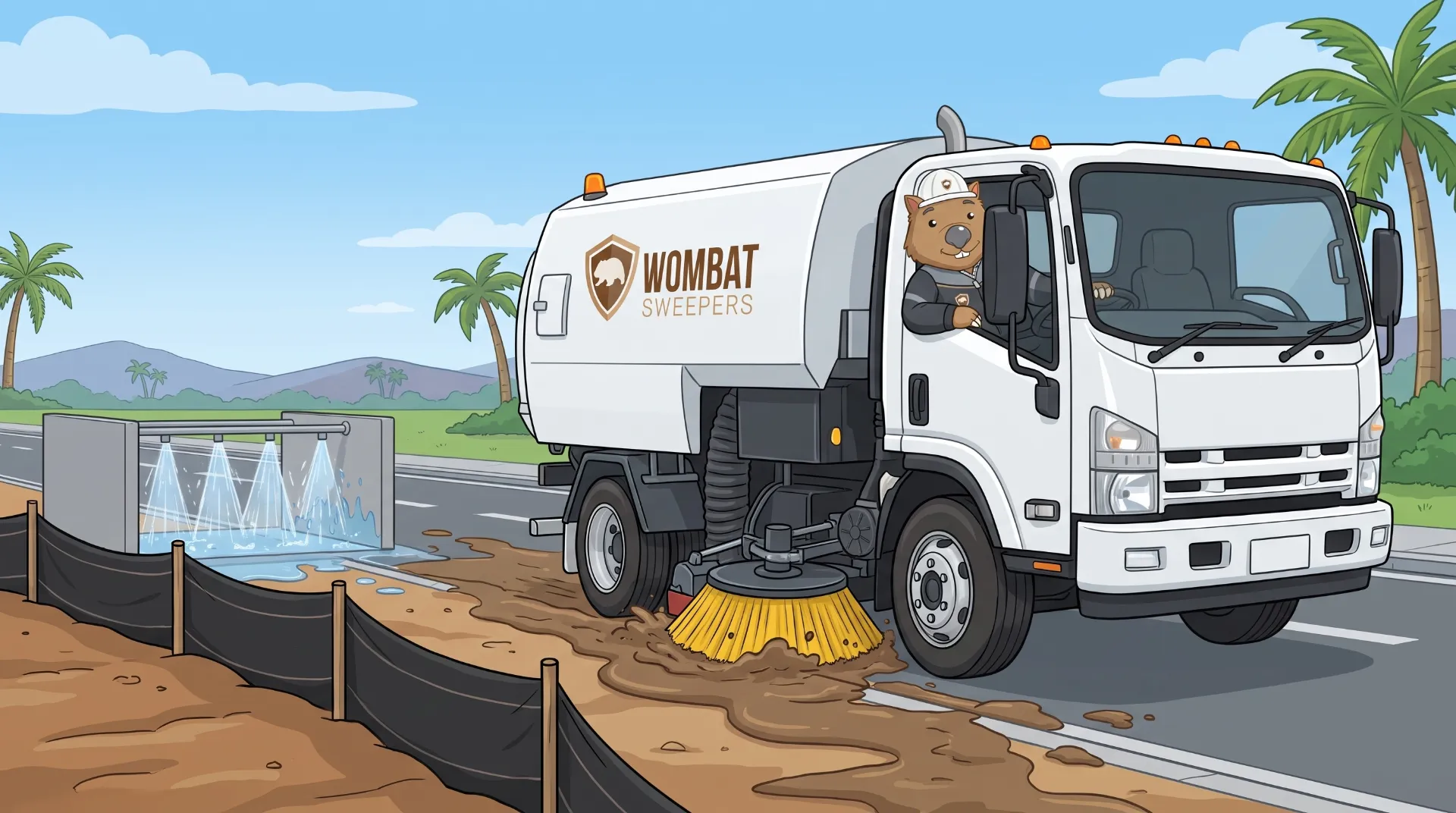
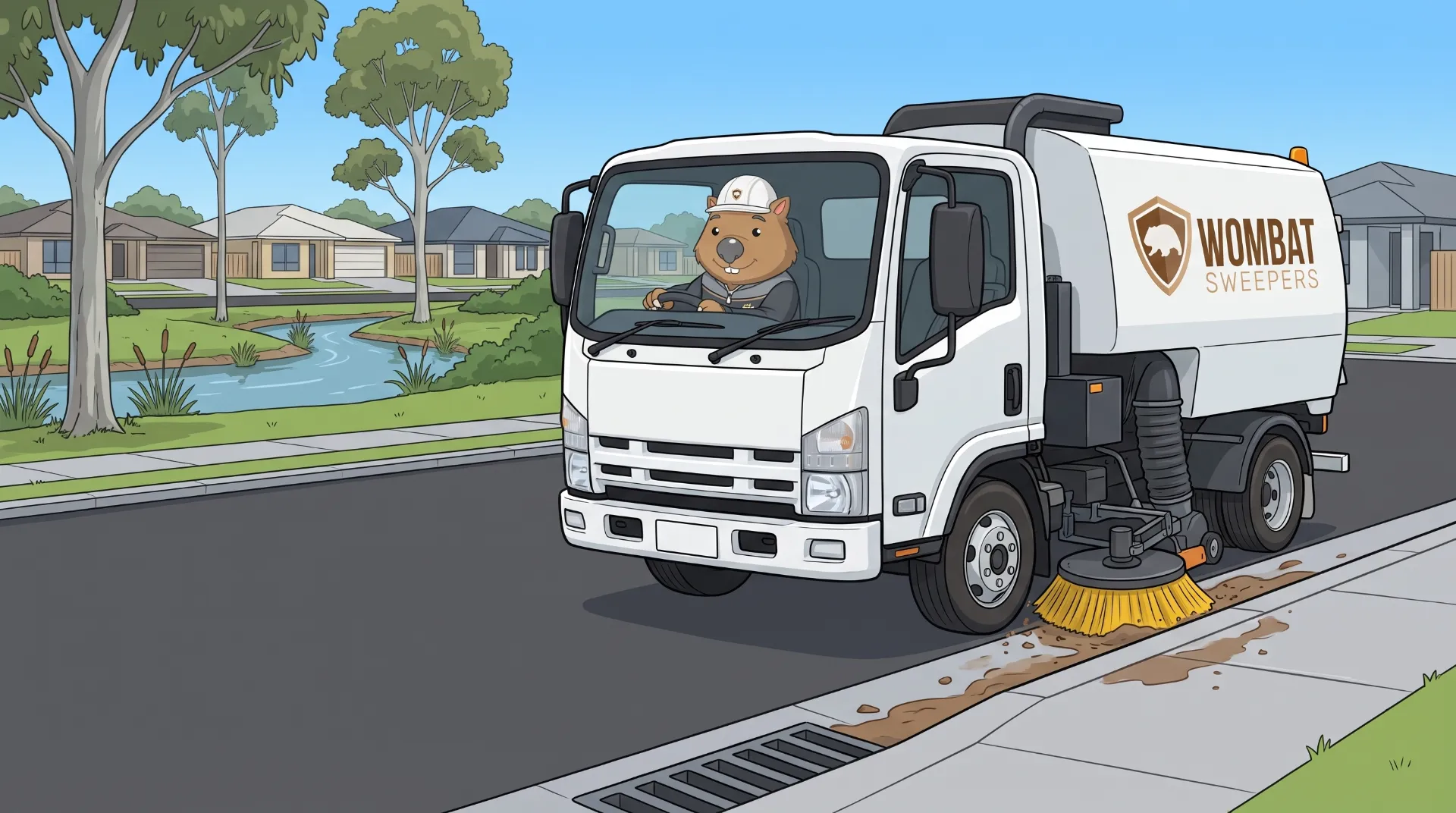
Trucks leave a site with material on their wheels and body. That material drops onto the sealed road at and beyond the exit. Rain mobilises it, the kerb and channel carries it to the nearest gully pit, and the stormwater network delivers it — untreated — to a creek. Every control in an erosion and sediment control plan exists to interrupt that pathway at some point along it. Sweeping interrupts it at the road.
The controls that work together
| Control | Where it acts | Limitation |
|---|---|---|
| Stabilised site exit | At the boundary, before material reaches the road | Degrades under heavy traffic and needs maintenance |
| Shaker or rumble grid | At the exit, dislodging material from wheels | Ineffective once clogged; does not catch body-carried material |
| Wheel wash | At the exit, on heavily muddy sites | Water management and cost; creates its own wet-tracking risk |
| Street sweeping | On the sealed road, removing what still got through | Cannot keep up with an unstabilised exit — it cleans up after it, daily |
| Gully pit protection | At the stormwater inlet, as the last line | Must be maintained or it blocks and causes local flooding |
The sequencing point matters: sweeping alone is not a sediment control strategy. If your exit is not stabilised, sweeping becomes a daily cost rather than a periodic one — which is usually more expensive than fixing the exit.
What actually triggers a directive
Someone photographs it. A resident, a council officer or the principal contractor sees mud across the road at your exit, and a phone call becomes a directive with a deadline on it. Scheduled sweeping is cheaper than a clean-up order and considerably cheaper than a penalty.
The test we use on site is simple and worth adopting: is there material visible on the sealed road at the end of the day? If yes, the frequency is wrong or the exit is failing.
Frequency that holds up
| Site stage | Frequency | Why |
|---|---|---|
| Bulk earthworks and heavy truck movements | Daily to every second day | Material arrives faster than it can accumulate safely |
| Structure and civil works | Weekly | Mud has largely stopped; grit and spoil continue |
| Fit-out and finishing | Fortnightly to monthly | Occasional deliveries rather than continuous haulage |
| Practical completion | One-off hand-over sweep and scrub | Final condition for hand-over and defect sign-off |
| Post-storm | Reactive | A single event can undo a month of control |
Evidencing the sweep
Keep a record, because the question always comes eventually. We can report runs completed, dates, machine hours and where captured material was disposed of, at whatever interval your plan or contract requires — which is normally exactly what an auditor or a council officer asks for.
For the obligations that attach to your specific approval, the authoritative sources are your local government’s conditions and Queensland Government environmental guidance at qld.gov.au. For practice guidance on erosion and sediment control, the International Erosion Control Association Australasia publishes the reference material most consultants work from, and Healthy Land & Water reports on waterway condition across South East Queensland.
Sediment control questions
Something else? Call 1300 387 713 and talk to someone who runs the machines.
Why is sediment on the road a stormwater problem?
Because it does not stay on the road. The first decent downpour washes it into the gully pits and through the stormwater network into creeks and, in South East Queensland, eventually Moreton Bay. Sweeping removes the material before the rain moves it.
Is street sweeping a recognised sediment control?
Yes. On Queensland civil and construction sites, sweeping of sealed surfaces beyond the site exit is one of the standard controls named in erosion and sediment control plans, alongside a stabilised exit, shaker or rumble grids and wheel wash.
Who is responsible for cleaning material tracked onto a public road?
The party that put it there. In practice that means the principal contractor or the site occupier, and councils commonly attach the obligation as a condition of approval.
Does a street sweeper clean gully pits?
A sweeper clears the grate and the channel around it so water can enter. Cleaning out the pit itself is a different service — an eductor or vacuum truck.
What happens to the material you collect?
It is captured in the hopper and disposed of at a facility licensed to accept it. We can supply the dates, runs and disposal record if your ESCP requires evidence.